Contents
9th Class Pairing Scheme 2026 – All Subjects (Punjab Boards)
9th Class Pairing Scheme 2026 – All Subjects (Punjab Boards)
Are you a 9th-class student in Punjab preparing for the **First Annual Exam in 2026**? Studying smart is just as important as studying hard. This official **9th Class Pairing Scheme 2026** is your ultimate guide to understanding exactly how your question papers will be structured. 🎯
We’ve broken down the complete, new paper pattern for Physics, Chemistry, Biology, Mathematics, Computer Science, and Urdu. This scheme, issued by the **Punjab Education, Curriculum, Training and Assessment Authority (PECTAA)**, helps you focus your efforts on the most important chapters for multiple-choice questions (MCQs), short questions (SQs), and long questions (LQs). Let’s dive in!
What is a Pairing Scheme and Why Is It Vital?
A pairing scheme (also known as a paper scheme or assessment scheme) is a blueprint issued by the education board. It details which chapters will be combined to create your exam questions. 📚
- Focus Your Study: Know which chapters to prioritize for long questions versus short questions.
- Reduce Stress: Eliminates uncertainty about the exam format so you can prepare with confidence.
- Maximize Marks: By understanding the weightage of each chapter, you can allocate your study time efficiently to score higher marks.
Official PECTAA 9th Class Pairing Scheme 2026
Below is the detailed breakdown for all science and arts subjects for the First Annual Exam 2026.
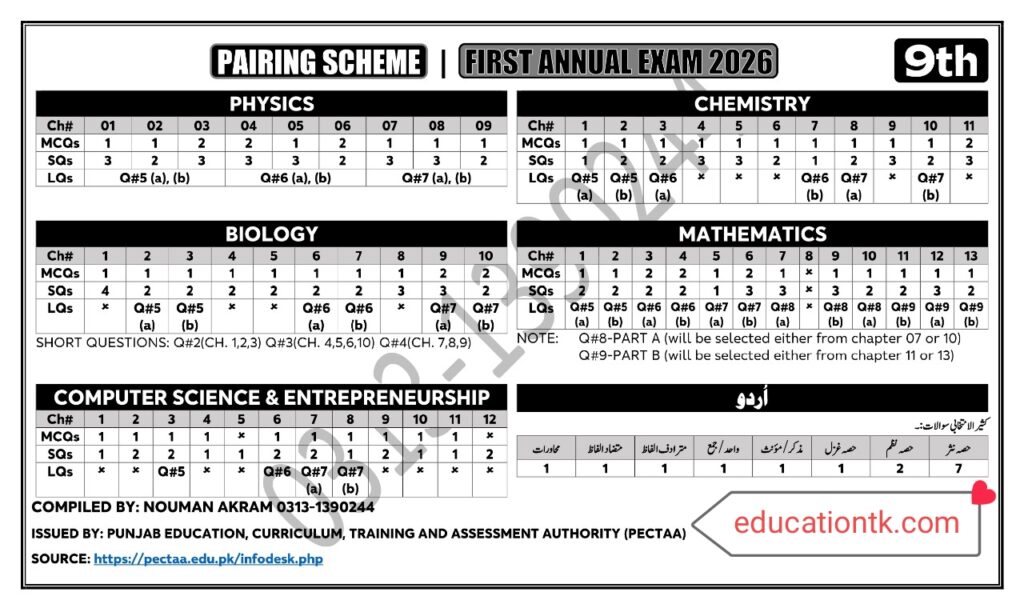
Physics Pairing Scheme 2026 (9th Class)
| Ch# | MCQs | SQs | LQs |
|---|---|---|---|
| 1 | 1 | 3 | Q#5 (a), (b) |
| 2 | 1 | 2 | |
| 3 | 2 | 3 | Q#6 (a), (b) |
| 4 | 2 | 3 | |
| 5 | 1 | 3 | Q#7 (a), (b) |
| 6 | 2 | 2 | |
| 7 | 1 | 3 | – |
| 8 | 1 | 3 | – |
| 9 | 1 | 2 | – |
Chemistry Pairing Scheme 2026 (9th Class)
| Ch# | MCQs | SQs | LQs | |
|---|---|---|---|---|
| 1 | 1 | 1 | Q#5 (a) | Q#5 (b) |
| 2 | 1 | 2 | ||
| 3 | 1 | 2 | – | – |
| 4 | 1 | 3 | Q#6 (a) | Q#6 (b) |
| 5 | 1 | 3 | ||
| 6 | 1 | 2 | – | – |
| 7 | 1 | 1 | Q#7 (a) | Q#7 (b) |
| 8 | 1 | 2 | ||
| 9 | 1 | 3 | – | – |
| 10 | 1 | 2 | – | – |
| 11 | 2 | 3 | – | – |
Biology Pairing Scheme 2026 (9th Class)
| Ch# | MCQs | SQs | LQs | |
|---|---|---|---|---|
| 1 | 1 | 4 | – | – |
| 2 | 1 | 2 | Q#5 (a) | Q#5 (b) |
| 3 | 1 | 2 | ||
| 4 | 1 | 2 | – | – |
| 5 | 1 | 2 | Q#6 (a) | Q#6 (b) |
| 6 | 1 | 2 | ||
| 7 | 1 | 2 | Q#7 (a) | Q#7 (b) |
| 8 | 1 | 3 | ||
| 9 | 2 | 3 | – | – |
| 10 | 2 | 2 | – | – |
- Q#2 will be from Chapters 1, 2, 3.
- Q#3 will be from Chapters 4, 5, 6, 10.
- Q#4 will be from Chapters 7, 8, 9.
Mathematics Pairing Scheme 2026 (9th Class)
| Ch# | MCQs | SQs | LQs | |
|---|---|---|---|---|
| 1 | 1 | 2 | Q#5 (a) | Q#5 (b) |
| 2 | 1 | 2 | ||
| 3 | 2 | 2 | Q#6 (a) | Q#6 (b) |
| 4 | 2 | 2 | ||
| 5 | 1 | 1 | Q#7 (a) | Q#7 (b) |
| 6 | 2 | 3 | ||
| 7 | 1 | – | Q#8 (a) | Q#8 (b) |
| 8 | – | 3 | ||
| 9 | 1 | 3 | Q#9 (a) | Q#9 (b) |
| 10 | 1 | 2 | ||
| 11 | 1 | 2 | ||
| 12 | 1 | 3 | – | – |
| 13 | 1 | 2 | – | – |
- Q#8-PART A: Will be selected from either Chapter 07 or 10.
- Q#9-PART B: Will be selected from either Chapter 11 or 13.
Computer Science & Entrepreneurship Scheme 2026
| Ch# | MCQs | SQs | LQs | |
|---|---|---|---|---|
| 1 | 1 | 1 | – | – |
| 2 | 1 | 2 | Q#5 (a) | Q#5 (b) |
| 3 | 1 | 2 | ||
| 4 | 1 | 1 | Q#6 (a) | Q#6 (b) |
| 5 | – | 1 | ||
| 6 | 1 | 2 | – | – |
| 7 | 1 | 2 | Q#7 (a) | Q#7 (b) |
| 8 | 1 | 1 | ||
| 9 | 1 | 2 | – | – |
| 10 | 1 | 1 | – | – |
| 11 | 1 | 1 | – | – |
| 12 | – | 2 | – | – |
Urdu Pairing Scheme 2026 (9th Class)
For Urdu, the MCQs are divided by grammar and literature sections as follows:
| Part / Topic | Multiple Choice Questions (MCQs) |
|---|---|
| Hissa Nasr (Prose) | 7 |
| Hissa Nazam (Poem) | 2 |
| Hissa Ghazal (Ghazal) | 1 |
| Muzakkar / Muannas (Masculine / Feminine) | 1 |
| Wahid / Jama (Singular / Plural) | 1 |
| Mutaradif (Synonyms) | 1 |
| Mutazad (Antonyms) | 1 |
| Muhavare (Idioms) | 1 |
Source and Authoritativeness (EEAT)
This pairing scheme is not guesswork. It is compiled based on the official guidelines and curriculum framework provided by the **Punjab Education, Curriculum, Training and Assessment Authority (PECTAA)**. As the governing body, PECTAA sets the standards for all Punjab boards, including BISE Lahore, BISE Rawalpindi, BISE Multan, and others.
This ensures the information is trustworthy, authoritative, and expert-driven. For further verification, you can always cross-reference with information from the official PECTAA infodesk.
Conclusion: Your Strategy for Success
Understanding the **9th Class Pairing Scheme 2026** is the first step toward achieving excellent marks in your First Annual Exam. This guide provides the clear, authoritative breakdown you need to plan your studies effectively. Focus on the chapter combinations for long questions and ensure you cover all chapters for MCQs and short questions.
Save this page, share it with your classmates, and start your focused preparation today! 💡
What subject are you most worried about? Let us know in the comments below!
Frequently Asked Questions (FAQs)
Q1: Is this 9th class pairing scheme 2026 final?
This scheme is based on the official guidelines from PECTAA for the 2026 annual exams. While it is considered final, the board always reserves the right to make minor changes. We recommend using this as your primary study guide and checking with your school for any last-minute updates.
Q2: Does this pairing scheme apply to all Punjab boards?
Yes. PECTAA issues a unified curriculum and assessment framework. This 9th class pairing scheme 2026 applies to all nine educational boards in Punjab, including BISE Lahore, Rawalpindi, Multan, Faisalabad, Gujranwala, Sargodha, Sahiwal, Bahawalpur, and DG Khan.
Q3: What is PECTAA?
PECTAA stands for the Punjab Education, Curriculum, Training and Assessment Authority. It is the government body responsible for setting the curriculum, textbooks, and assessment standards (like pairing schemes) for schools and boards across the Punjab province.
Q4: How can I download the 9th class pairing scheme 2026 PDF?
While this web page provides the complete scheme in an easy-to-read format, official PDF documents are often released by PECTAA or individual boards closer to the exam. You can check the official websites or use this page as your reliable source for the 2026 scheme.
Q5: How do pairing schemes help students score better?
Pairing schemes help you study efficiently. For example, if you know Chapter 1 and Chapter 2 are paired for a long question, you can master the key topics from both to ensure you can answer that question perfectly. It prevents wasting time on chapters that are not paired for LQs.
Q6: Where can I find 9th class guess papers for 2026?
Guess papers are often based on these official pairing schemes. While this scheme tells you *which* chapters to study, guess papers try to predict *which* specific questions will come. Always use the pairing scheme as your main guide and guess papers as secondary revision tools.
Q7: Will the pairing scheme for 2026 be different from 2025?
Pairing schemes can change from year to year based on curriculum updates. This scheme is specifically for the 2026 First Annual Exam. Using outdated schemes from previous years can be risky, so it’s crucial to follow the latest official 2026 version provided here.
Q8: What is the paper pattern for 9th class practicals?
The pairing scheme above covers the theory exams (written papers). The practical exams for Physics, Chemistry, and Biology have a separate pattern, which usually involves performing experiments, a practical notebook, and a viva voce (oral questions). Your school will provide the list of required practicals.
Q9: How many short questions do I need to attempt?
Your question paper will have multiple sections of short questions (e.g., Q#2, Q#3, Q#4). Each section will consist of a certain number of questions (e.g., 9 questions), and you will be required to attempt a smaller number (e.g., 6 out of 9). This scheme tells you which chapters each section will draw from.
Q10: The math scheme mentions ‘either/or’ for Q#8 and Q#9. What does that mean?
It means the examiner has a choice. For Q#8 (Part A), the question could come from Chapter 7 OR Chapter 10. To be safe, you should prepare the long questions from both chapters. Similarly, for Q#9 (Part B), prepare for both Chapter 11 and Chapter 13.